
Breathing New Life into Bi-Lateral Relief
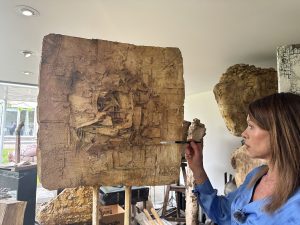
At the FE McWilliam Gallery and Studio, we are committed to preserving and celebrating the legacy of one of Ireland’s most important sculptors. As part of the continued development of our gallery spaces, we have undertaken a careful programme of conservation to prepare key works for public display. When the new Collection Gallery opens later this year, visitors will have the opportunity to experience Bi-Lateral Relief – a significant maquette that has undergone expert conservation by conservator Claire Magill, to ensure it can be safely and beautifully presented for years to come.
Read below Claire’s account of the process…
A Sculpture Reimagined
When visitors step into the new FE McWilliam Collection Gallery, they’ll encounter a striking piece of modernist sculpture – Bi-Lateral relief – standing proud and stable. But behind its poised presence lies a story of fragility, craftsmanship, and meticulous conservation. Since 2011, I’ve worked on an annual rolling program of conserving FE McWilliam’s maquettes and master models, gaining an intimate understanding of his artistic approach, materials, and construction techniques. This experience proved invaluable when tackling one of the most challenging projects yet: preparing Bi-Lateral for safe public display.
The Conservation Journey
Working in close consultation with the curator, Dr Riann Coulter, we devised a treatment plan that balanced structural integrity with showcasing the sculpture in its best light, alongside other large-scale sculptures.
Step 1: Stabilization – A custom steel plate with stabilizing dowels was designed and fabricated to support the sculpture discreetly.
Step 2: Cleaning – Gentle dry cleaning with pony hair brushes, followed by wet cleaning with hogs hair brushes, revealed the original surface beneath years of accumulated grime.
Step 3: Consolidation & Repair – Using 10% Paraloid B72 in acetone, I consolidated fragile areas. Losses were filled with fine dental plaster, then retouched with Golden acrylics to harmonize with the original finish.
Step 4: Documentation – Every stage was photographed and recorded, for future reference.
View video here: https://canva.link/3ksiw43h9721qgk